
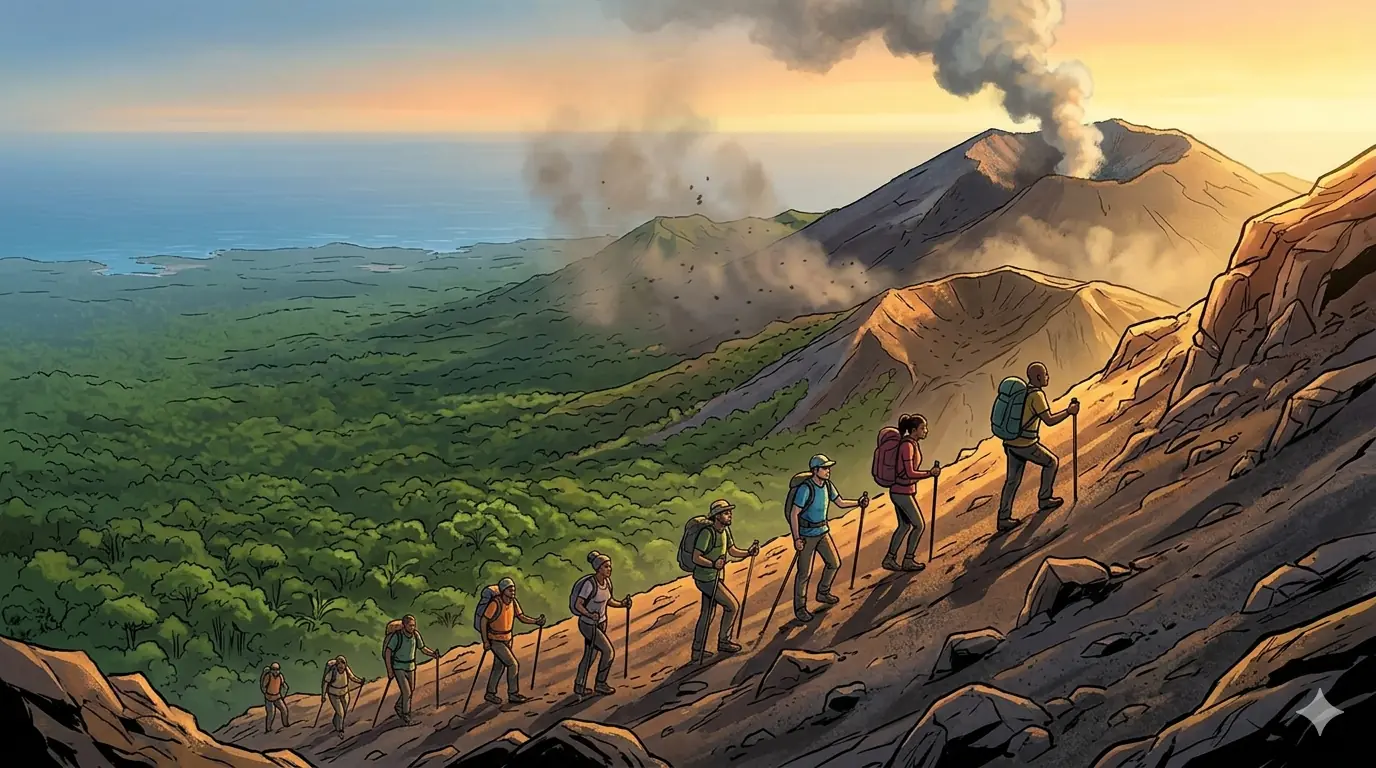
West Africa's highest peak and one of Africa's most active volcanoes, Mount Cameroon offers one of the continent's most dramatic and rewarding mountain experiences. Here's everything you need to know to plan your ascent.
Known locally as Fako or the "Chariot of Fire," Mount Cameroon is a stratovolcano of extraordinary beauty and power. Rising to 4,095 metres above the coastal town of Buea, it is West Africa's highest peak, one of Africa's most active volcanoes, and one of the continent's most rewarding mountain experiences. Unlike many of Africa's great peaks, Mount Cameroon is geologically very much alive — its most recent major eruption occurred in 2000, and the summit area still features steaming fumaroles that serve as a dramatic reminder of the fire within.
A Living Volcano: Mount Cameroon's Geological Story
Mount Cameroon's volcanic history is written across its flanks in rivers of solidified lava. Major eruptions recorded in 1922, 1954, 1959, 1982, 1999, and 2000 have each added new lava flows, creating dramatic black basaltic landscapes where the sea of molten rock consumed everything in its path. Walking through these lava fields — where forest has begun to regenerate at the edges, creating a striking contrast between living green and dead black stone — is a geological experience unlike anything else in West Africa.
The Climb: Three Days Through Multiple Worlds
The standard ascent follows the Mann Spring Route, a demanding but manageable hike for those in reasonable fitness. The three-day format includes an overnight camp at Mann Spring (approximately 2,800m) and a second camp before the summit push. The descent is typically completed in a single day.
What makes the climb truly extraordinary is the journey through multiple climate zones. The lower slopes pass through cultivated fields and coffee plantations, giving way to dense montane forest draped in moss and cloud. Above the treeline, the landscape transforms into open meadows of everlasting flowers and giant lobelias — plants that seem to belong on another planet. Finally, bare lava fields lead to the summit plateau, where on clear days the views stretch across the Gulf of Guinea to the island of Bioko in Equatorial Guinea.
The Race of Hope: An Extraordinary Human Achievement
Each year, the Mount Cameroon Race of Hope sees elite athletes from across Africa and the world race up and down this massive volcano — approximately 40 kilometres with 4,000 metres of elevation gain and loss — in under five hours. Watching this extraordinary display of human endurance is an unforgettable experience.
Practical Information for Climbers
Climbers must hire guides from the Mount Cameroon Ecotourism Organisation (MCEO) in Buea. The best time to climb is during the dry season (October to March). Accommodation in Buea ranges from guesthouses to comfortable hotels. Limbe, just 25km away, offers excellent post-climb relaxation with Atlantic Ocean beaches.
Global Bush Travel arranges complete Mount Cameroon climbing packages including guides, porters, camping equipment, meals, transport from Douala or Limbe, and pre- and post-climb accommodation.