
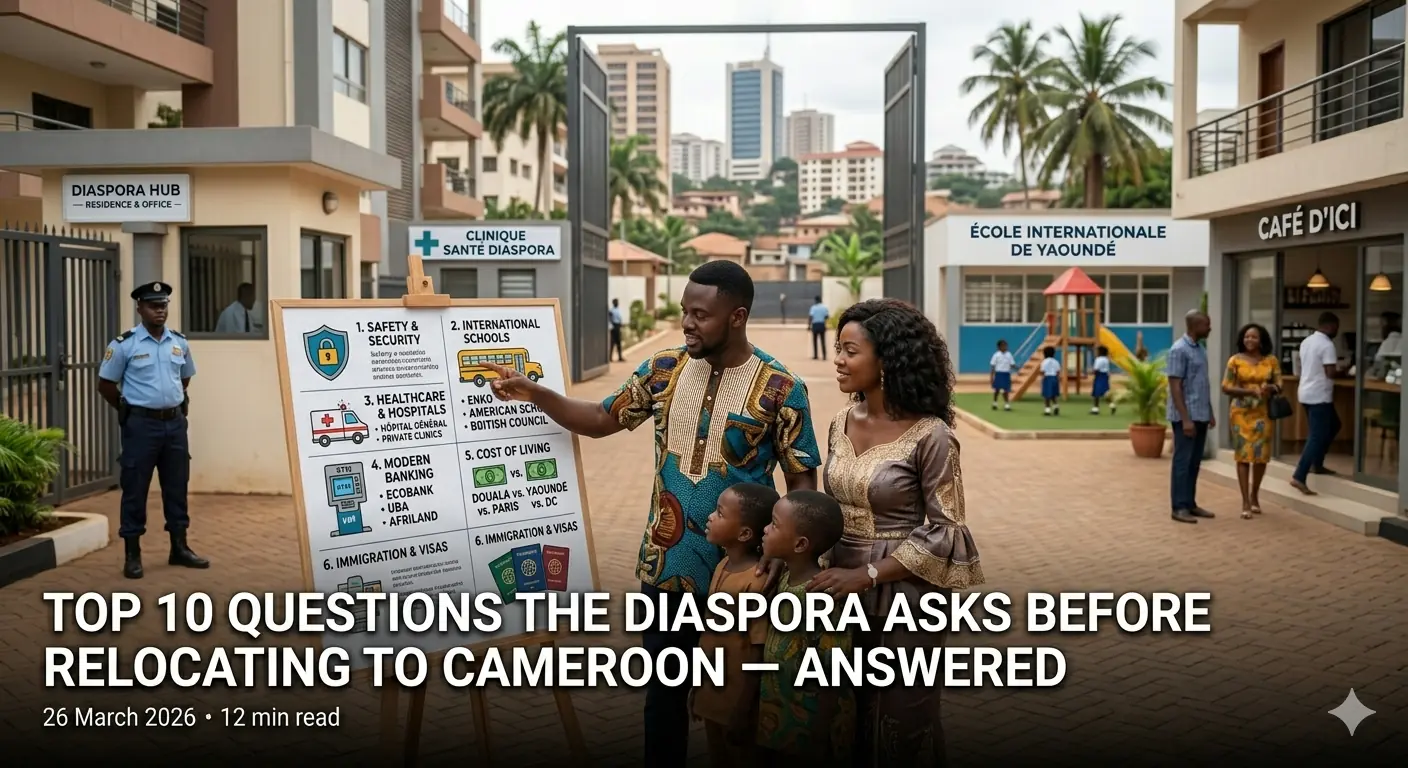
From safety and schools to healthcare and banking, we answer the most common concerns of diaspora families planning a move to Douala, Yaoundé, or beyond.
Every day, we receive messages from Cameroonians abroad who are seriously considering returning home. They ask the same practical questions — about safety, education, medical care, bureaucracy, and lifestyle. Here are the honest answers, based on real client experiences and on‑the‑ground knowledge.
1. Is Cameroon safe for my family?
Most urban areas and tourist destinations are safe for families. Like any major city, Douala and Yaoundé have petty crime — take standard precautions. Avoid the Northwest and Southwest regions (Anglophone crisis) and border areas with CAR and Chad. We never send clients into unsafe zones. Many diaspora families live comfortably in secure neighbourhoods with 24/7 guards and gated communities.
2. What about international schools?
Yaoundé has the American School of Yaoundé (accredited, US curriculum), the École Française (French curriculum), and the International School of Yaoundé (IB). Douala has the Douala International School, École Française, and Rainbow International School. Fees range from €3,000–8,000 per year — significantly cheaper than Europe or North America.
3. How is healthcare?
Private clinics in major cities are good for routine care and minor emergencies. For serious conditions, many diaspora members choose medical evacuation to South Africa or Europe — which is why comprehensive travel/health insurance is non‑negotiable. Pharmacies are well‑stocked. We recommend the Clinique Bastos (Yaoundé) and Clinique des Généraux (Douala).
4. Can I open a bank account as a diaspora?
Yes. Major banks (SCB Cameroun, BICEC, Afriland, UBA) welcome diaspora clients. You'll need your passport, proof of address (can be a letter from your host), and sometimes a residency permit. Some banks allow remote account opening with a notarised power of attorney. Global Bush Travel can facilitate introductions.
5. How do I deal with bureaucracy?
Cameroonian administration can be slow and paperwork‑heavy. The key is hiring a local "courrier" or fixer who knows which office, which officer, and which stamp you need. For residency permits, driver's licence conversion, or land registration, don't go alone. We can recommend trusted agents.
6. Can I keep my remote job and pay taxes?
Many diaspora returnees work remotely for foreign companies. Tax obligations depend on your residency status and double‑taxation treaties. Consult a bilingual accountant in Cameroon — it's often advantageous to become a tax resident here due to lower rates.
7. What's the social life like?
Vibrant. Douala and Yaoundé have a thriving nightlife — bars, live music (bikutsi, makossa), restaurants, and cultural events. There are diaspora meetups, expat groups, and business clubs. You won't feel isolated.
8. How do I ship my belongings?
Several international movers offer door‑to‑door container service from Europe or North America to Douala port. Expect 4‑8 weeks and budget €2,000–5,000 for a 20ft container. Be careful with duties on used household goods — a customs broker is essential.
9. Is it easy to get around without a car?
For daily life, yes — taxis and moto‑taxis are everywhere and cheap. For weekend trips or moving a family, hiring a 4x4 with a driver is safer and more comfortable than renting yourself. Global Bush Travel provides verified drivers.
10. Will I regret it?
Almost no one who makes the move with proper preparation regrets it. The challenges are real, but the rewards — belonging, freedom, financial peace — are greater. Start with a 2‑4 week "look‑see" trip. We'll design an itinerary that answers all your remaining questions.