
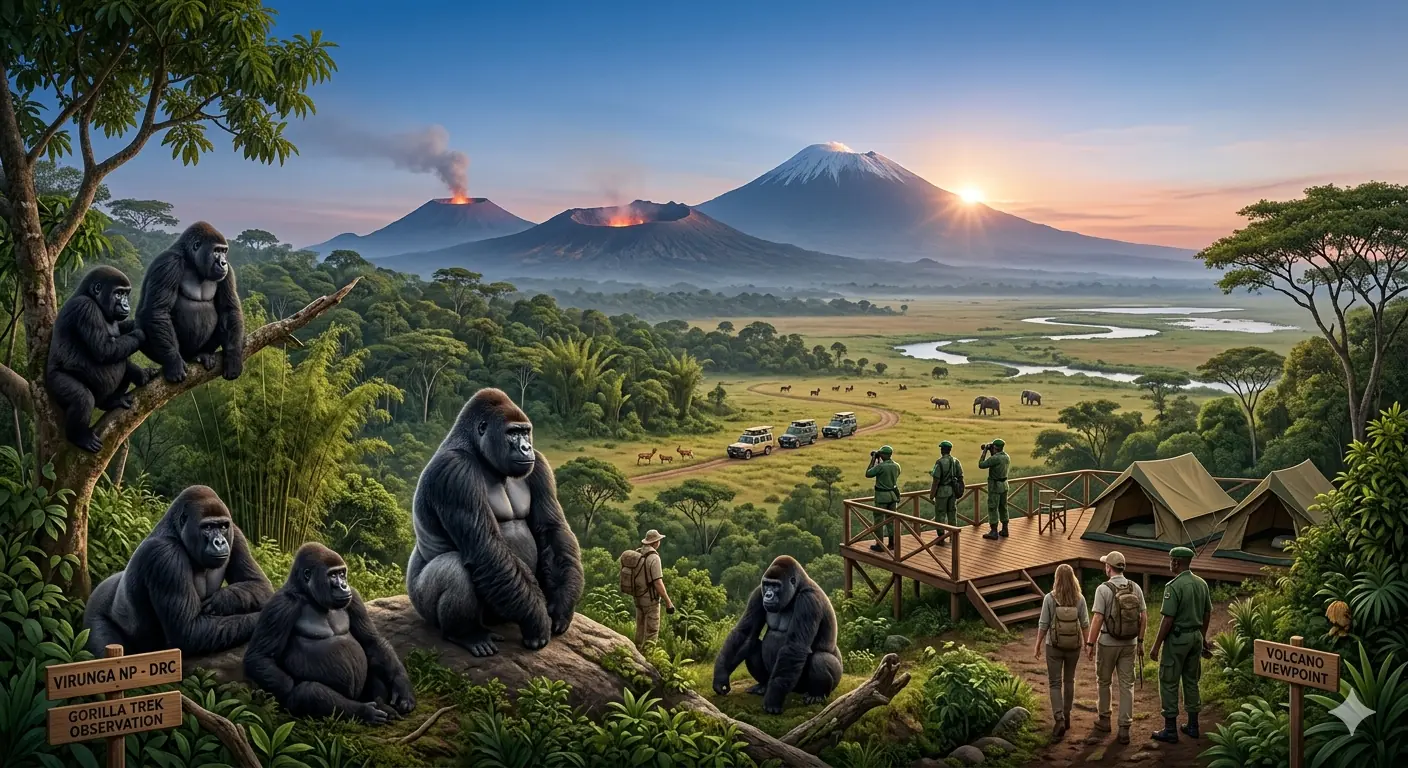
Home to mountain gorillas, active volcanoes, and a pioneering community‑based conservation model, Virunga is a must‑visit for the intrepid traveler. Here's how to do it safely and responsibly.
Virunga National Park in the Democratic Republic of the Congo is a place of superlatives. Established in 1925, it is Africa's oldest national park, a UNESCO World Heritage Site, and one of the most biodiverse places on Earth. It is home to roughly a third of the world's remaining mountain gorillas, as well as active volcanoes (Nyiragongo with the world's largest lava lake), vast lava plains, and the endangered okapi [citation:3][citation:4].
For the diaspora, visiting Virunga is an opportunity to support one of the continent's most ambitious conservation efforts. The park's community‑based programs employ thousands of locals, and tourism revenue directly funds anti‑poaching patrols and community development. Over 700 rangers protect the park; more than 200 have lost their lives in service [citation:10].
Current Security Situation (2026 Update)
As of 2026, Virunga's security situation requires careful consideration. Due to ongoing armed conflict in North Kivu province, the park has experienced periodic closures. Travelers should be aware that:
- Gorilla trekking and Nyiragongo hikes may be suspended depending on security conditions [citation:10]
- When open, all activities require mandatory armed ranger escorts and must be booked through licensed operators [citation:3][citation:4]
- The U.S. State Department advises Level 4 (Do Not Travel) for North Kivu, including Virunga and Goma [citation:5][citation:10]
- Only travel with reputable operators who coordinate directly with ICCN (Institut Congolais pour la Conservation de la Nature) [citation:7][citation:8]
Top Experiences (When Open)
Mountain gorilla trekking: With over 200 mountain gorillas in the park, Virunga offers one of the world's most unforgettable wildlife encounters. Permits are limited and must be booked well in advance. Trekking occurs only in monitored, secured zones like the Mikeno sector, with armed ranger escorts [citation:4][citation:9].
Climb Mount Nyiragongo: Hike to the summit of this active volcano to witness the world's largest lava lake — a surreal, other‑worldly experience. Overnight hikes require certified mountain guides and strict adherence to safety protocols [citation:3][citation:8].
Chimpanzee habituation: The park's Tongo chimpanzee area offers the chance to spend a day with semi‑habituated chimps.
Senkwekwe Center: Visit the world's only mountain gorilla orphanage, where you can learn about the park's conservation work.
Practical Safety Tips
- Book exclusively through licensed operators with real‑time security updates [citation:6][citation:7]
- Monitor official travel advisories from your government and the park's official site (visitvirunga.org) [citation:10]
- Secure comprehensive travel insurance with medical evacuation coverage [citation:4][citation:9]
- Obtain all required vaccinations: yellow fever (mandatory), typhoid, hepatitis A/B, and malaria prophylaxis [citation:4][citation:9]
- Cross into DRC via the Grande Barrière border post from Gisenyi (Rwanda) with your tour operator's assistance [citation:8]
- Never travel independently — always follow ranger instructions [citation:4]
Alternatives: Uganda and Rwanda
For travelers prioritizing safety above all else, Uganda's Bwindi Impenetrable National Park and Rwanda's Volcanoes National Park offer excellent gorilla trekking experiences with greater stability and well‑developed tourism infrastructure [citation:10].
Global Bush Travel can arrange complete packages including permits, transfers, and accommodations, ensuring a safe and enriching visit when conditions permit.